What to do when your fish dies, one step at a time
When a fish dies, confirm it has really gone, lift it out with a net, test the water for the fish still living there, and chill or freeze the body while you decide on cremation, burial or a communal goodbye. None of it needs to be settled tonight.
By the Fish Cremation & Memorial Services editorial team · Updated September 24, 2026 · 6 min read · Sources
- Tell a torpid pond fish from a dead one
- Protect the tank mates left behind
- Choose ashes, burial or communal calmly
Step one
How can you be sure your fish has actually died?
Look for three things together: no gill movement for several minutes, no reaction when you touch the body gently with a net, and a body that has stiffened, sunk or turned pale. If all three are true, your fish has died. If even one is missing, wait and watch a little longer before you do anything final.
A tank fish and a pond fish can fool you in different ways. In an aquarium, a fish with a swim bladder problem may float on its side or rest upside down for hours and still be alive. In an outdoor pond in late fall or winter, koi and goldfish slow almost to a standstill once the water gets cold. They sit near the bottom, barely fanning their fins, and breathe so slowly you can miss it. A still fish in icy water is usually resting, not dead.
Step two
How do you get the body out of a tank or pond?
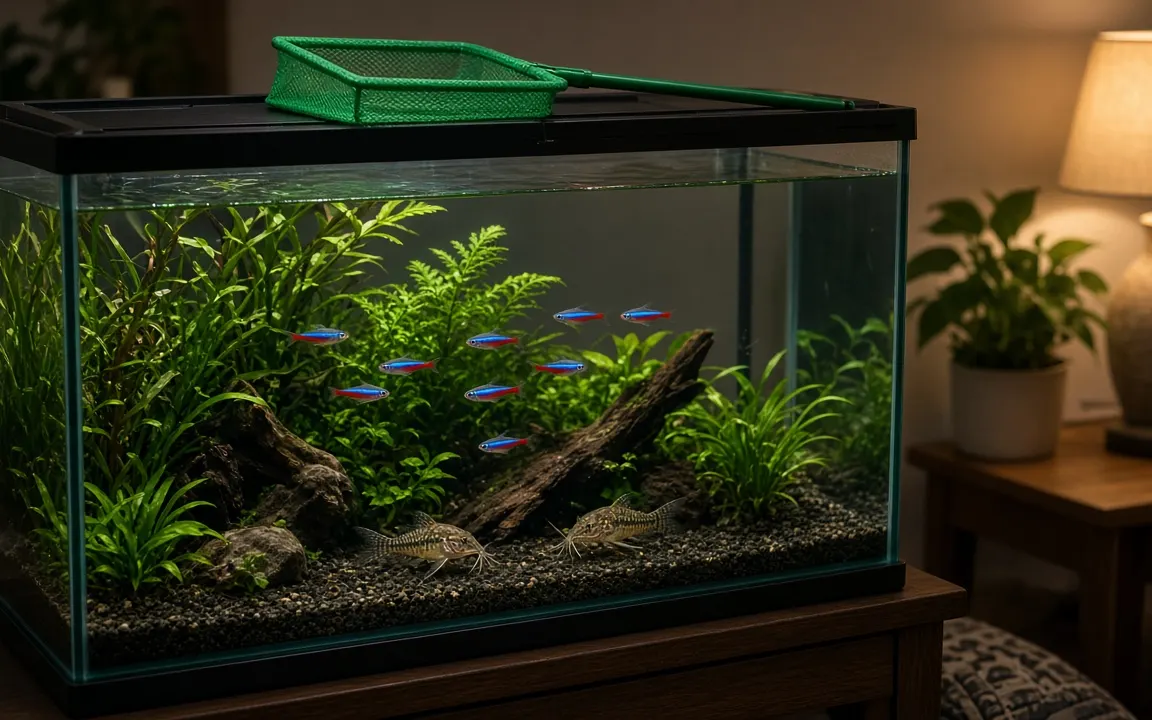
Use a net, not your bare hand, and move slowly so the other fish don't panic. For a small aquarium fish, a standard fine-mesh net is enough; slide it under the body and lift. For a large pond goldfish or koi, a wide pan net lets you guide the body toward the edge, and a pair of household gloves makes lifting easier. Lay the fish on a folded paper towel or an old hand towel.
If you can't see the body, look again before bed. Small fish hide behind rocks, filters and plants when they're failing, and a body lost in a planted tank or under a lily pad can foul the water within a day or two in summer. Wash your hands afterwards too; the CDC's advice for fish owners explains that tank water can carry germs. Then rinse the net, soak it in a dilute bleach solution for a few minutes, then rinse it well and air-dry it before it touches the water again.
Step three
Why should you check the other fish and test the water today?
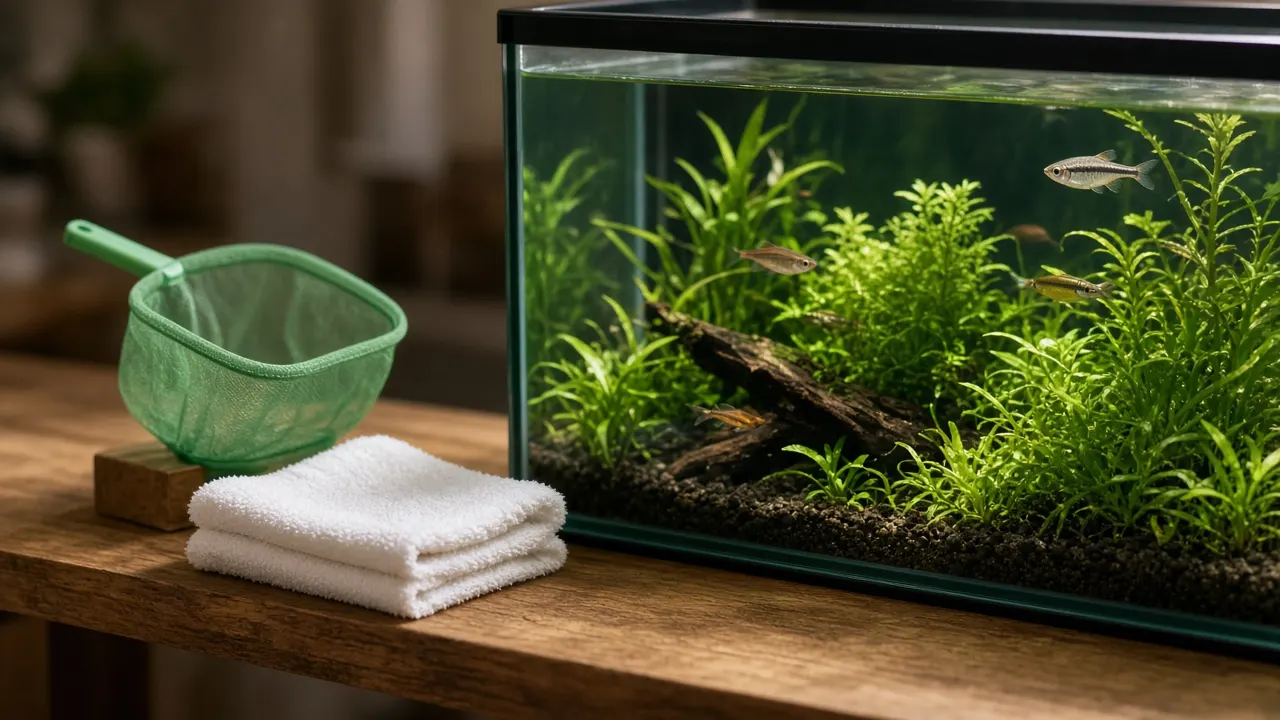
Most fish don't live alone. The American Pet Products Association found 77%[1] of US fish owners keep two or more, so one death is often an early warning for the rest. Whatever killed your fish, whether it was poor water, a sudden temperature change or an infection, may still be in the tank or pond.
- Test the water for ammonia, nitrite, nitrate, pH and temperature. Strip tests are fine for a first look; liquid kits are more precise.
- Watch the survivors for clamped fins, gasping at the surface, white spots, frayed tails or hiding.
- Check the equipment: heater, filter flow, air pump and, in a pond, the pump and any UV clarifier.
- Change some water if readings look off, around a quarter at a time, using dechlorinated water at a matching temperature.
Write the readings down with the date. If another fish becomes ill, those numbers help a vet or an experienced store work out what happened. If a large pond fish died without warning and you'd like the cause investigated, keep the body chilled rather than frozen and call an aquatic vet today.
Step four
Where do you keep the body while you decide what to do?
Cold buys you time. A day or two in the fridge is fine for a quick decision; the freezer gives you weeks or months. Place the fish inside two sealed layers, such as a zip bag inside a lidded tub, and label it clearly so nobody in the household opens it by surprise.
Apartment living makes this trickier. A small freezer compartment may not fit a big goldfish, and roommates may not share your view of the arrangement. A quick conversation helps, and so does a plain, opaque container on a separate shelf. For a large koi that won't fit anywhere, an ice chest in a cool garage or shaded balcony works for a day or so if you top up the ice morning and evening.
Would you keep your fish in the freezer while you decide what to do?
Tap an answer to vote and see how others answered. Anonymous.
If a provider needs to collect a big fish, our guide to moving a koi or pond fish safely explains how to pack it for the trip.
Avoid these
What shouldn't you do with a dead fish?
- Don't flush it. It's quick, but it sends the body and anything it carried into the sewer, and for many children it feels like the fish was thrown away.
- Don't drop it in a lake, stream or storm drain. Aquarium fish can carry parasites and bacteria that wild fish have never met. Minnesota's natural resources agency is blunt about unwanted goldfish: never release[2] them into public waters. A dead fish tipped into a creek raises some of the same disease worries.
- Don't bin it in a trash bag. It's legal in many places, but most people find it wrong: 64% of US owners in one survey rated a trash bag unacceptable for a pet's body [3].
- Don't bury it beside the pond. Rainwater can carry what's in the soil straight back to the fish you still keep.
- Don't leave it in the water overnight to see if it recovers, once you're certain. Decay raises ammonia fast in a small tank.
Step five
Ashes, burial or communal cremation: which suits your fish?
Size decides a lot. Cremated remains usually weigh about 3-5% of body weight[4], so a big koi or a decades-old pond goldfish can come back as a real handful of ashes, while a betta or neon tetra leaves almost nothing that can be gathered as its own. If you want something physical to keep and your fish was small, a burial or a memorial may give you more than cremation can. For comparison, our estimate from UK and US surveys is that about two in three bereaved owners of all pets choose cremation and about 30% choose burial[5]; for fish, size tips the balance. The ashes weight estimator shows where yours falls.
- Private cremation suits larger fish when you want the ashes back. Read how private and communal fish cremation differ before you book.
- Communal cremation is a respectful, lower-cost goodbye for any size, often from about $50 [6], with no ashes returned.
- Home burial remains common; in one UK survey 27% of owners buried their pet at home [7]. A deep hole away from water is the key.
- A memorial without remains, such as a new water lily or a painted stone, works for the tiniest fish.
The comparison tool below weighs these side by side on cost, effort and what you keep. If you'd like to see what's offered where you live, the local pages cover prices and rules by area, and our services overview explains each option.

Free tool
Aftercare options compared
Compare private, communal and water cremation with burial on cost, timing and what comes home.
Step six
How do you tell a child their fish has died?
Plainly and soon. Say that the fish died, that its body stopped working and it can't come back. Avoid "went to sleep" or "swam away", which can confuse young children or make bedtime frightening. Resist the overnight lookalike swap; children often notice, and the lesson they learn is that grown-ups hide things.
Give them a job. A child can draw a picture of the fish, choose a pebble from the tank to keep, or help pick a plant. Parents often feel unsure here, and they aren't alone: 93.4%[8] of parents in a large UK survey wanted better guidance on helping children through a pet's death. Our ten-minute aquarium goodbye ideas are written with families in mind.
Afterward
What clean-up does the tank or pond need afterward?
Usually less than you'd think. If your other fish look healthy and the readings are normal, a partial water change and a gravel vacuum around the spot where the body lay are enough. Stripping a tank completely can crash the helpful bacteria in the filter and cause the very problem you're trying to avoid.
If you decide to close the tank or pond for good, rehome any survivors through a store, a local fish club or a keeper you know, never a park pond or creek. Bag up used plants and gravel for the trash rather than tipping them outdoors, since aquarium plants and snails can spread in the wild too. When you're ready, tell us about your fish and we'll email what's available nearby. For the harder days after, our piece on grieving a fish you loved may help.

Reader polls
What would you choose?
Vote anonymously and see how other readers answered. The results are live counts from people who visit this site, so they show real opinions, not a scientific sample.
Would you keep your fish in the freezer while you decide what to do?
Tap an answer to vote and see how others answered. Anonymous.
When did you (or will you) decide on aftercare?
Tap an answer to vote and see how others answered. Anonymous.
If you had to decide today, which aftercare would you choose for your pet?
Tap an answer to vote and see how others answered. Anonymous.


Questions people ask
How long after a fish dies does it start to smell?
In warm aquarium water, a body can begin to break down and cloud the water within a day, and a noticeable smell can follow soon after. In a cold pond the process is much slower. Out of the water at room temperature, a small fish will start to smell within hours, which is why chilling or freezing it quickly makes the next steps easier.
Why did one fish die overnight when the others look fine?
Sometimes the answer is simple: age, an internal problem or an injury that affected only that fish. But water issues often hit the weakest fish first, so test ammonia, nitrite and temperature anyway. If the readings are normal and the survivors eat and swim well over the next week, it was probably an individual problem rather than a tank-wide one.
Should I get a replacement fish straight away?
It's wiser to wait two to three weeks. That gives you time to see whether the other fish stay healthy and lets the water settle after any changes. Adding a new fish to a tank that may carry an infection puts the newcomer at risk too. When you do add one, a separate quarantine tank for a few weeks is the careful approach.
Can I put a dead fish in the garden compost?
It's not a good idea. An open compost heap can attract raccoons, rats, foxes and neighborhood cats, and a fish that died of an infection shouldn't go anywhere near soil used for food. A properly dug burial, a communal cremation or a freezer while you decide are all gentler and more hygienic choices.
My fish is floating but its gills still move. What should I do?
It is still alive. Floating often points to a swim bladder problem, constipation or poor water quality rather than death. Test the water, check the temperature and ask an aquatic vet or an experienced fish store for advice. If the fish is clearly suffering and won't recover, ask a vet about humane euthanasia rather than flushing it.
Do I have to decide on cremation or burial the same day?
No. Once the body is sealed and in the freezer, there's no deadline. Many families take a week or more to talk it over, especially when children are involved or a big koi needs a plan. The one exception is if you want a vet to investigate the cause of death, which needs a chilled, unfrozen body quickly.
Keep reading


Sources and our estimates
- [1] 77% of U.S. fish owners keep two or more fish (APPA 2025). American Pet Products Association - From Bigger Tanks to Stronger Bonds: Fish & Reptile Ownership Evolves in 2025, 2025.
- [2] Minnesota DNR advises owners of unwanted goldfish to return them to a retailer, use a surrender event, rehome with hobbyists, or ask a veterinarian or pet retailer about humane disposal, never releasing them. Minnesota DNR - Goldfish (Carassius auratus) invasive species page.
- [3] 64% of US owners rated a trash bag as an unacceptable container for a deceased pet; 66.1% rated a blanket/shroud acceptable. Cooney, Kogan, Brooks, Ellis - Pet Owners' Expectations for Pet End-of-Life Support and After-Death Body Care, Topics in Companion Animal Medicine (2020), 2020.
- [4] Embrace notes cremated remains typically weigh about 3-5% of the pet's original body weight. Embrace Pet Insurance - Bury or Cremate Your Dog? Costs, Pros & Cons, 2025.
- [5] UK and US survey evidence converges on roughly two-thirds of bereaved owners choosing cremation (UK 67%; US 68% ever) and about 29-32% choosing burial. Our estimate: mean(67, 68) = 67.5; burial range 29% (UK) to 32% (US). How we calculate.
- [6] PetMD says US group (communal) cremation costs from about $50 and private cremation from about $100. PetMD - Pet Euthanasia: How Much Does It Cost? (July 2025), 2025.
- [7] In the same CMA survey, 27% of UK owners buried their pet at home and 2% used a pet burial company elsewhere. UK Competition and Markets Authority - Veterinary services for household pets, Provisional decision report Part A (Oct 2025), 2025.
- [8] 93.4% of parents in the RSPCA survey wanted better guidance on helping children through pet loss. RSPCA — Pet Loss Survey Results, 2026.
Get fish aftercare options near you
Tell us what you need and where you are. We'll reply by email with clear options and prices so you can decide in your own time.