Small goodbye rituals when an aquarium fish dies
A goodbye for a tank fish can take ten minutes: gather whoever cared for it, say its name and one thing you'll remember, then do one small act together, such as burying it under a plant or drawing it. Leave the tank quiet for a day before changing anything.
By the Fish Cremation & Memorial Services editorial team · Updated September 24, 2026 · 6 min read · Sources
- Ten-minute rituals for families, kids and offices
- Looking after the tank and the fish that remain
- Honest words for children, and when to restock
The short answer
What's a simple, meaningful way to say goodbye to a tank fish?
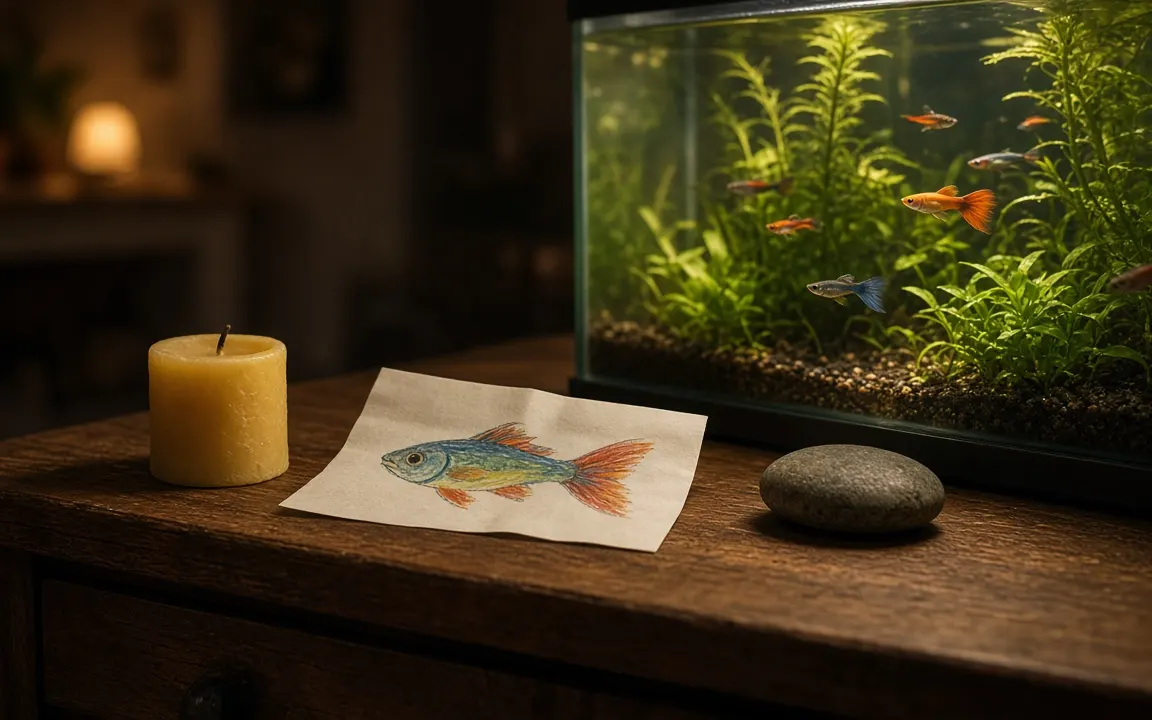
Keep it short and real. Bring together everyone who fed or watched the fish, say its name aloud, let each person share one memory, then do one physical thing: lower it into a small grave, place a stone, light a candle by the tank or draw a picture. Ten minutes is enough, and it matters more than any product.
A ritual gives a loss a beginning and an end. Without one, a fish can simply vanish from the tank overnight, which leaves children confused and adults quietly unsettled. Grief tracks closeness, not size: a US study comparing pet and human loss found closeness to the one who died was the strongest predictor of how hard grief hits [1], whatever the species. A betta you greeted every morning can be missed more than you'd expect. By our estimate, up to about 1 in 15 UK adults may have had a pet's death hit them harder than any human loss[2].
34.5%[3]
Ideas you can use today
Which ten-minute rituals suit families, kids, solo keepers and workplaces?
- For a family: gather by the tank after dinner with the lights low. Each person finishes the sentence "I'll remember when..." Then walk together to a flower bed or a large pot, where the youngest can place the first handful of soil.
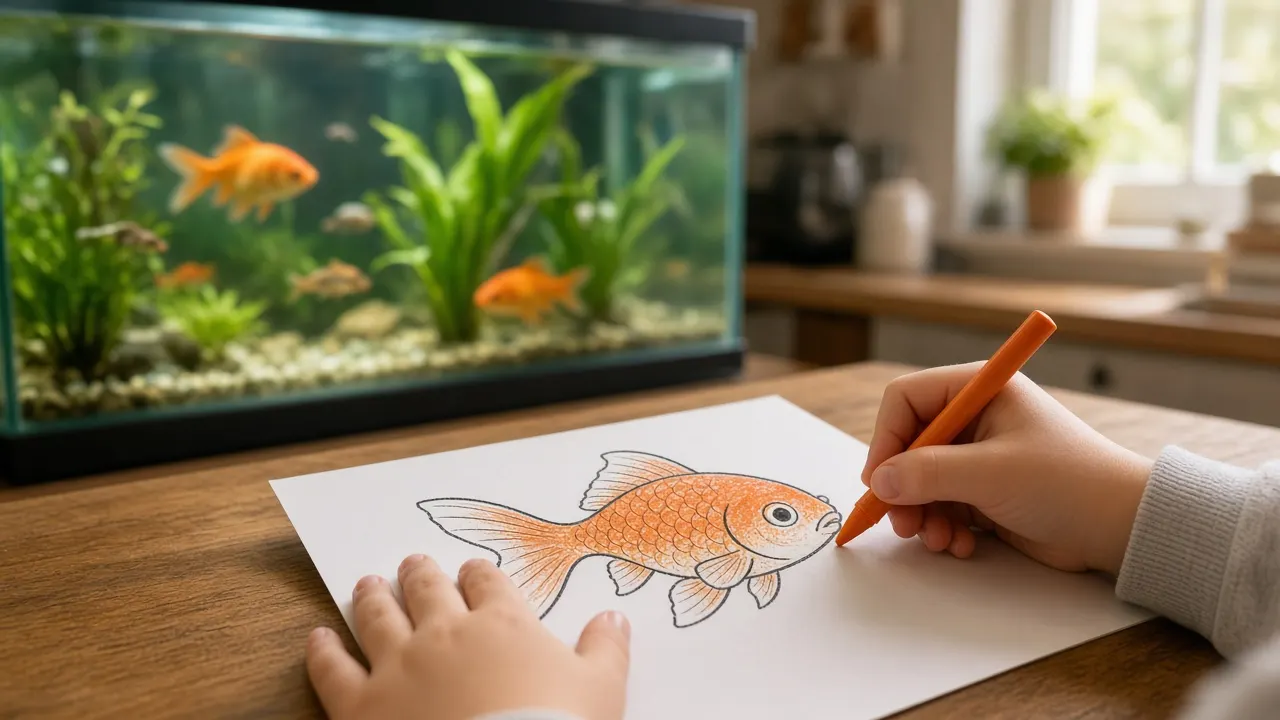
- For a young child: let them choose a box, line it with a tissue and decorate the lid with the fish's name. They carry it, you dig. Afterward, they choose a stone or a toy to mark the place.
- For a solo adult: make tea, sit in front of the tank for a few minutes and write a short note to the fish: how long you had it, the quirk you'll miss. Fold it into the grave, or keep it in the aquarium logbook.
- For an office or classroom tank: announce it simply, invite anyone who wants to add a line to a shared card, and hold a two-minute gathering at the tank before the next meeting or lesson.
If the fish is being cremated, the ritual can happen at the handover instead of a grave. For small fish there may be little or nothing to return, which our guide to fish ash yields explains, so the goodbye itself often becomes the main memorial. The services page lists every option, from burial to water cremation.
Talking with kids
How do you explain a fish's death to a child honestly?
Use the real word. "Bubbles died. Her body stopped working and she can't swim, eat or feel anything now." Phrases like "went to sleep" or "swam away" feel softer but can frighten young children about bedtime or leave them waiting for the fish to come back. Answer the questions they ask, and it's fine to say "I don't know" about why.
Avoid the overnight swap. Replacing a dead goldfish with a lookalike before a child notices is a common instinct, but children often do notice, and the lesson they learn is that loss is hidden rather than shared. Parents plainly want help here: 93.4%[4] of parents in the RSPCA's large pet-loss survey wanted better guidance on supporting children.
Was a fish your child's first pet?
Tap an answer to vote and see how others answered. Anonymous.
Expect questions to come back days later, often at bath time or in the car. That's normal, not a sign the ritual didn't work. Our article on grief after losing a fish covers adults and teens as well as young children.
The fish that remain
What should you do with the tank after a fish dies?
Most fish keepers have company in the tank: 77%[5] of US fish owners have two or more. So the tank still has residents, and they come first. Don't strip and scrub everything: the filter's beneficial bacteria keep ammonia in check, and a deep clean can crash them.
- Test the water the same day for ammonia, nitrite, nitrate and pH, and note the temperature.
- Do a modest partial water change, around a quarter, with dechlorinated water at the same temperature.
- Remove uneaten food and check behind decor and in the filter intake for anything decaying.
- Watch the others for a week: clamped fins, gasping, white spots, frayed fins or hiding.
- Consider leaving the tank lights off for the rest of the day. Dim, quiet water lowers stress for survivors, and it gives the household a pause too.
Something to keep
Could you make a gyotaku print or another keepsake?
Gyotaku is the Japanese art of printing a fish by brushing it with ink and pressing rice paper over it. Fishermen once used it to record a catch; today some keepers use it as a memorial for a larger goldfish, oscar or koi. Use non-toxic water-based ink, work gently, and rinse the fish before burial or cremation. It isn't for everyone, and it's wise to try it with adults only unless a child asks.
Gentler keepsakes need no contact with the fish at all: a favorite tank ornament kept on a shelf, a photo print of the aquarium in its prime, a child's drawing framed, or a stone painted in the fish's colors. If you'd like to plan something more lasting and see what it costs, the budget planner below adds it up, and our memorial ideas for fish has more to choose from.

Free tool
Memorial budget planner
Add up cremation, urn, keepsakes and a farewell so the total holds no surprises.
Shared tanks
How do you handle a death in an office or classroom tank?
A shared tank has many caretakers and no clear owner, so decide quickly who will remove the fish and who will tell everyone. Remove it before the room fills if you can, then share the news plainly rather than letting people discover an empty corner.
In a classroom, a short circle time where children say what they liked about the fish, followed by drawings pinned beside the tank, is often enough. Let the class help decide whether and when to get another. In an office, a card by the tank and a line in the team chat acknowledges the loss without making it awkward. If a colleague was the fish's main carer, a quiet word helps; UK research found only 13.4%[6] of bereaved pet owners felt fully understood by others.
Want ideas for a burial spot or a biodegradable option on shared grounds? See our guide to biodegradable memorials for fish.
Looking ahead
When is it right to get another fish?
There are two clocks: the tank's and yours. The tank is ready when water tests stay stable for a couple of weeks and the remaining fish look healthy. If disease was suspected, ask an aquatic vet or knowledgeable store about treating or resting the tank first, and quarantine any newcomer in a separate tank for a few weeks.
You're ready when a new fish feels like a new fish rather than a replacement. For some families that's a week; for someone who kept the same fancy goldfish for years, it can be months. There's no right answer, and choosing not to restock is valid too.
How long before you felt ready for another pet?
Tap an answer to vote and see how others answered. Anonymous.
See how other keepers answered on the poll results page. If the loss is weighing on you, free pet-loss lines such as Cornell's Pet Loss Support Hotline [7] and Tufts University's helpline are open to anyone. And if you'd like aftercare options for your fish, send us a short note and we'll reply by email.

Reader polls
What would you choose?
Vote anonymously and see how other readers answered. The results are live counts from people who visit this site, so they show real opinions, not a scientific sample.
Was a fish your child's first pet?
Tap an answer to vote and see how others answered. Anonymous.
How long before you felt ready for another pet?
Tap an answer to vote and see how others answered. Anonymous.
What helped you most in the first weeks?
Tap an answer to vote and see how others answered. Anonymous.


Questions people ask
Should I let my child see the dead fish?
If they want to, yes, briefly and calmly. Seeing the still fish helps young children understand that death is real and final. Rest it on a soft cloth, explain what they'll see, and let them decide how close to get. Don't insist if they'd rather not look; they can still help with the box, the drawing or the stone.
Is it silly to hold a ritual for a goldfish?
Not at all. A short goodbye is how people mark any relationship that mattered, and you may have fed that goldfish every day for years. Rituals also help children learn how to grieve safely, with the grown-ups nearby. Ten minutes and a few honest words are enough; nobody needs to make a speech.
Should I turn off the aquarium light after a fish dies?
Turning the lights off for the rest of the day is a reasonable, gentle step. Lower light reduces stress for the remaining fish while you test the water and look for problems. Keep the filter and heater running as normal, and switch the lights back on the next day on their usual schedule.
How soon can I add new fish after one died?
Wait until you know the tank is stable: water tests steady for a couple of weeks and the remaining fish eating and behaving normally. If an infection was possible, allow longer and ask an aquatic vet or experienced store. Quarantining new arrivals separately for a few weeks protects the fish you already have.
What words can I say at a fish's goodbye?
Keep it simple and specific: the fish's name, how long you had it, and one thing it did that made you smile, such as racing to the glass at feeding time. You might end with "Thank you for being part of our home." Children often like to add their own line or read what they drew.
Can a classroom fish be buried at school?
Ask the school office or grounds staff first. Some schools welcome a small burial in a garden bed, while others prefer the teacher to take the fish home. A pot with a new plant on the classroom windowsill is a good compromise: children can water it and still see the memorial every day.


Sources and our estimates
- [1] A Death Studies paper comparing pet and human loss found closeness to the deceased was overwhelmingly the strongest predictor of grief severity, whatever the species. Europe PMC abstract — Eckerd, Barnett & Jett-Dias, 'Grief following pet and human loss: Closeness is key', Death Studies (2016), doi:10.1080/07481187.2016.1139014, 2016.
- [2] About 7 in every 100 UK adults may have had a pet's death hit harder than any human loss. Our estimate: 32.6% have lost a pet x 21% chose pet as most distressing. How we calculate.
- [3] 34.5% of bereaved pet owners were told 'it's just a pet'. RSPCA — Pet Loss Survey Results, 2026.
- [4] 93.4% of parents in the RSPCA survey wanted better guidance on helping children through pet loss. RSPCA — Pet Loss Survey Results, 2026.
- [5] 77% of U.S. fish owners keep two or more fish (APPA 2025). American Pet Products Association - From Bigger Tanks to Stronger Bonds: Fish & Reptile Ownership Evolves in 2025, 2025.
- [6] Only 13.4% of bereaved pet owners felt fully understood by others. RSPCA — Pet Loss Survey Results, 2026.
- [7] Cornell's free Pet Loss Support Hotline (607-218-7457) is staffed by veterinary students trained by professional grief counselors. Cornell University College of Veterinary Medicine, 2026.
Get simple aftercare options for a tank fish
Tell us what you need and where you are. We'll reply by email with clear options and prices so you can decide in your own time.