What size urn does a koi or goldfish need?
Fish ashes are small: pets leave about 3-5% of body weight[1], and fish can be lower still. Enter your fish's weight to find an urn that fits, without paying for empty space.
- Volume in cubic inches and milliliters
- Keepsakes for family included
- Sized for fish, not just dogs and cats
Urn size calculator
Enter your pet's healthy adult weight. We size the urn using the industry rule of 1 cubic inch per pound, plus 10% room to spare.
Recommended urn size
3.3 cu in (54 mL)
Look for: Small (up to 20 cu in)
| Total ashes (by volume) | 3 cu in (49 mL) |
|---|---|
| Expected ash weight | 1.4 oz–2.4 oz |
| Urn with 10% margin | 3.3 cu in (54 mL) |
Standard sizes: small up to 20, medium up to 60, large up to 120 and extra large 200+ cubic inches. If you're between sizes, choose the larger one.
Source: Embrace Pet Insurance - Bury or Cremate Your Dog? Costs, Pros & Cons; Our estimate. 1 cu in per lb is an industry rule of thumb
Next step: Find urns and prices near you →
Using the calculator
How to size an urn for your fish
Enter your fish's weight in pounds or kilograms. Then say how many people want a share, and whether you'd like keepsakes included. The calculator shows the main urn volume in cubic inches and milliliters and names the standard urn size that fits.
Urn makers sell by volume, not by weight, which is why the calculator converts. Standard sizes are roughly small (20 cubic inches), medium (60), large (120) and extra large (200 or more). Almost every fish lands in the small or keepsake range.
Free tool
Urn size calculator
Find the urn volume you need from your pet's weight, plus keepsake and sharing options.
The rule behind it
The one-cubic-inch-per-pound rule, and why it's generous for fish
The industry rule of thumb is one cubic inch of urn space for every pound of body weight. The calculator adds 10% as a margin, because ashes settle unevenly and a lid needs room to close. Our worked example of the rule gives a 12 lb cat about 12 cubic inches[2], and a koi of the same weight gets the same answer on paper.
That rule was built around mammals, whose bones are dense. Fish leave proportionally less, and a forensic study of 100 cremations found the smallest bodies returned only about 1% of their weight, so an urn sized by the rule will usually have spare room. That's a good thing: it means you won't find the urn too small, and the extra space can hold a folded note or a scale from the pond.
A worked example
Worked example: a 16 lb koi shared between three people
A 16 lb koi gives a main volume of about 16 cubic inches, or around 18 (288 mL) with the margin. That fits a small urn of 20 cubic inches with room to spare. Now set sharing to three people: each share is about 5.3 cubic inches, and the tool suggests an urn of about 5.9 cubic inches (96 mL) for each person. Tick keepsakes too and it first sets aside 3 cubic inches per person, 9 in total, leaving each person about 2.6 cubic inches (42 mL) for a second small urn. For a three-way split, one keepsake urn each may be all you need.
| Fish | Weight | Volume by the rule (+10%) | Suggested size |
|---|---|---|---|
| Jumbo koi | 25 lb | About 28 cu in (450 mL) | Medium urn |
| Mature koi | 16 lb | About 18 cu in (290 mL) | Small urn |
| Pond goldfish | 2 lb | About 2 cu in (36 mL) | Keepsake urn |
| Fancy goldfish or cichlid | 8 oz | Under 1 cu in | Pendant or tiny vial |
| Betta or tetra | A few grams | Well under 0.1 cu in | Consider a no-ash memorial |
Beyond size
Choosing an urn that suits a water animal
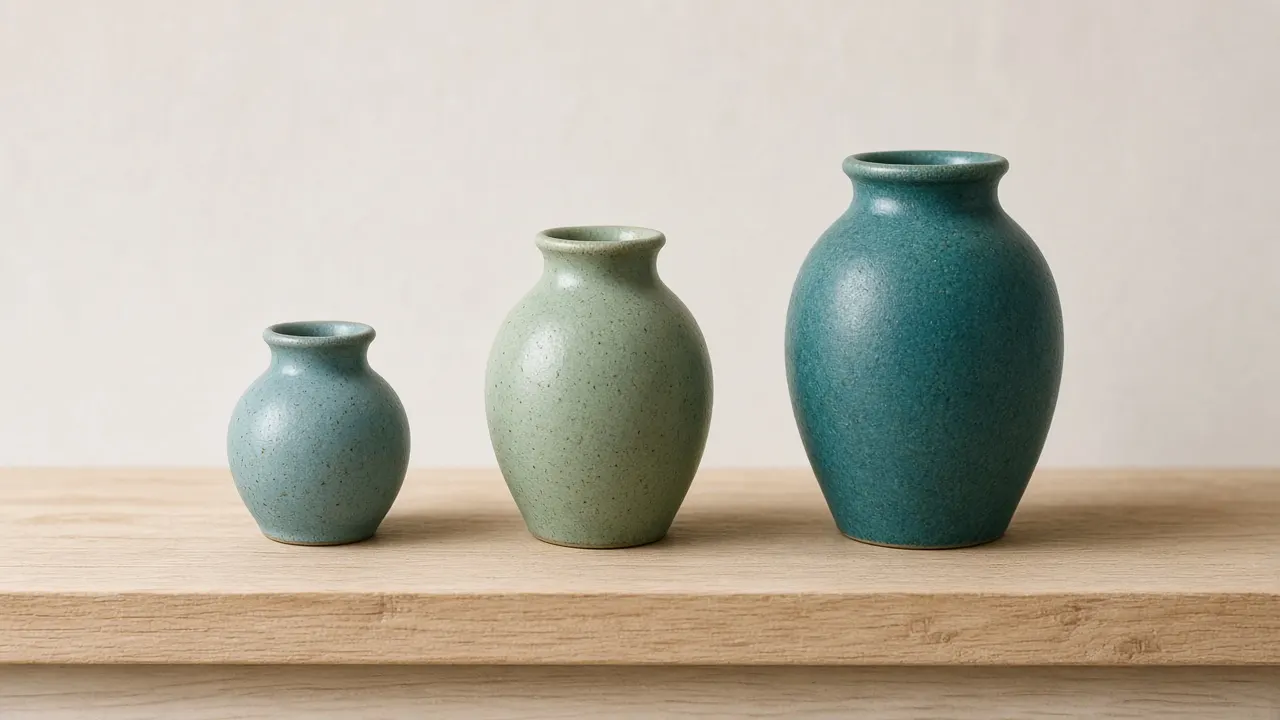
Because fish need small urns, you can often afford a nicer material. Hand-blown glass, glazed ceramic in pond blues and greens, carved stone and turned wood all come in keepsake sizes. Material moves the price more than size does: by our estimate, marble pet urns cost about three times ceramic ones[3]. One industry report puts personalized urns in the US at about USD 50–1,000+[4], and small ones sit at the lower end.
- Outdoors by the pond: choose stone or sealed ceramic, not wood.
- For scattering later: a simple container is enough; spend on a marker instead.
- For planting: a biodegradable urn works, but ashes are very alkaline and need mixing with soil first.
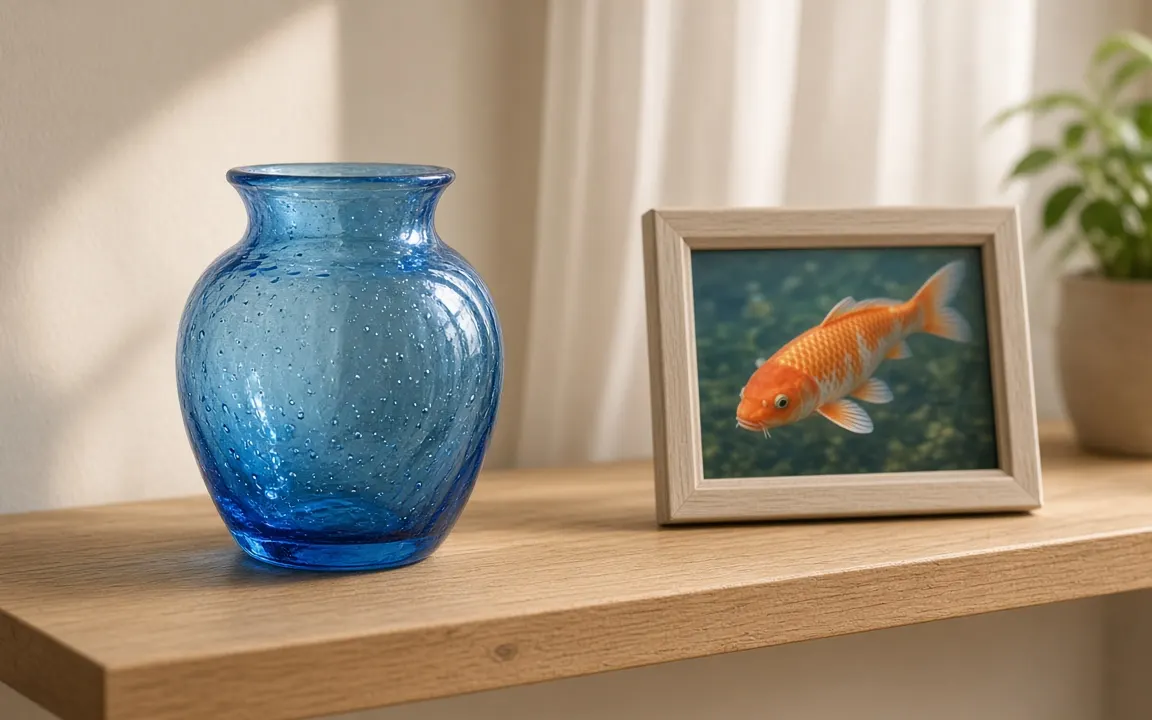
Some koi keepers like an urn that echoes the fish itself: a glaze in the same kohaku red and white, or a carved koi on the lid. Others prefer something plain and let a photo on the shelf beside it do the remembering. Either way, a small urn is easy to move if you ever leave the house with the pond. Koi can outlive a house move or two: Japan's koi promotion association puts their typical lifespan at 30-40 years[5].
Our guide to bio memorials after fish loss explains the planting route, and the pond-side markers guide has ideas for a memorial at the water's edge.
Which memorial feels right for a fish?
Tap an answer to vote and see how others answered. Anonymous.
Keep in mind
What the urn calculator can't tell you
It can't tell you the exact amount your provider will return, since processing varies. It doesn't know an urn maker's real internal volume, which is sometimes less than the label suggests. And for a very small fish, it can't make ash appear where there's almost none.
Ashes are also strongly alkaline, with a pH of ~11.7[6], which matters if you plan to plant them. Mix them with plenty of compost, and consider waiting before planting; one gardening guide suggests 90–120 days[7]. For shared ashes, the ashes sharing planner goes into more detail, and you can ask us about urns and providers for your area.
If you'd like to see all the costs together, including the urn, the memorial budget planner adds everything up, and our services page explains which cremation types return ashes at all.

Reader polls
What would you choose?
Vote anonymously and see how other readers answered. The results are live counts from people who visit this site, so they show real opinions, not a scientific sample.
Which memorial feels right for a fish?
Tap an answer to vote and see how others answered. Anonymous.
Where are (or will be) your pet's ashes?
Tap an answer to vote and see how others answered. Anonymous.
Which memorial feels most like your pet?
Tap an answer to vote and see how others answered. Anonymous.

Free tools to help you plan
Urn size calculator
Find the urn volume you need from your pet's weight, plus keepsake and sharing options.
Ashes sharing planner
Split ashes fairly between family members, keepsake urns and jewelry.
Ashes weight estimator
See roughly how much ash to expect back, by species and body weight.
Questions people ask
How big an urn does a koi need?
Usually a small urn of about 20 cubic inches. The rule of one cubic inch per pound, plus a 10% margin, puts even a large 16 lb koi under 20 cubic inches. Very large koi may need a little more, but fish ashes often come in below the rule anyway.
Is there an urn small enough for a betta?
Keepsake vials and pendants hold tiny amounts, but a betta may leave too little ash to collect at all. If your provider offers a token return, a small vial works. Otherwise, a framed photo, a plant or a tank ornament can be a more fitting memorial.
How many milliliters is a cubic inch?
One cubic inch is about 16.4 mL. So a 20 cubic inch urn holds roughly 330 mL, a little more than a can of soda. The calculator shows both units, since urn makers outside the US often list capacity in milliliters.
Can I keep my koi's urn outside by the pond?
Yes, if it's designed for outdoor use. Choose stone, sealed ceramic or metal with a watertight seal, and place it where it won't be knocked into the water. Some families prefer a solid stone marker outside and keep the urn indoors.
Do I need an urn at all for a fish?
No. Many families keep a koi's ashes in the simple container the provider returns, scatter them in the garden around the pond, or mix them into the soil of a new plant. An urn is worth buying when you want a lasting place for the ashes indoors, or when several people want their own small share.


Sources and our estimates
- [1] Embrace notes cremated remains typically weigh about 3-5% of the pet's original body weight. Embrace Pet Insurance - Bury or Cremate Your Dog? Costs, Pros & Cons, 2025.
- [2] Using the industry rule of thumb of 1 cubic inch of urn space per pound of body weight, a 12 lb cat needs an urn of about 12 cubic inches; a 70 lb dog needs about 70 cubic inches. Our estimate: urn cu in = body weight lb x 1 (industry rule of thumb, not a measured value). How we calculate.
- [3] Marble pet urns cost about 3 times ceramic ones, consistently across a price guide and a crematory price list. Our estimate: Memorials.com midpoints marble $190 / ceramic $60 = 3.2×; Final Gift marble $260 / ceramic figurine $90 = 2.9×. How we calculate.
- [4] Personalized pet urns range from about USD 50 to more than USD 1,000. Astute Analytica via GlobeNewswire — Global Pet Preservation Services Market to Hit USD 112.7 Million by 2032 (Apr 2, 2024), 2024.
- [5] Nishikigoi (koi) typically live about 30 to 40 years depending on their environment. All Japan Nishikigoi Promotion Association - Ancient koi 'Hanako', 2024.
- [6] Cremated remains have a very high pH of approximately 11.7, which is toxic to plants without amendment. Larkspur Conservation — Giving Cremated Remains a New Life Through Science, 2024.
- [7] Gardening Know How advises letting an ash/soil-amendment mixture sit for at least 90 to 120 days before planting. Gardening Know How — Planting With Cremains: Is There a Safe Way to Bury Ashes, 2024.
Find a provider and urn near you
Tell us what you need and where you are. We'll reply by email with clear options and prices so you can decide in your own time.