When a fish you love dies in Santa Fe
A pond koi and a tank tetra need very different goodbyes. Here's who in and around Santa Fe will cremate a fish, what it costs and what to do when there'll be almost no ash.
- What to do in the first hour
- What a small-pet minimum really costs
- Options emailed for your area
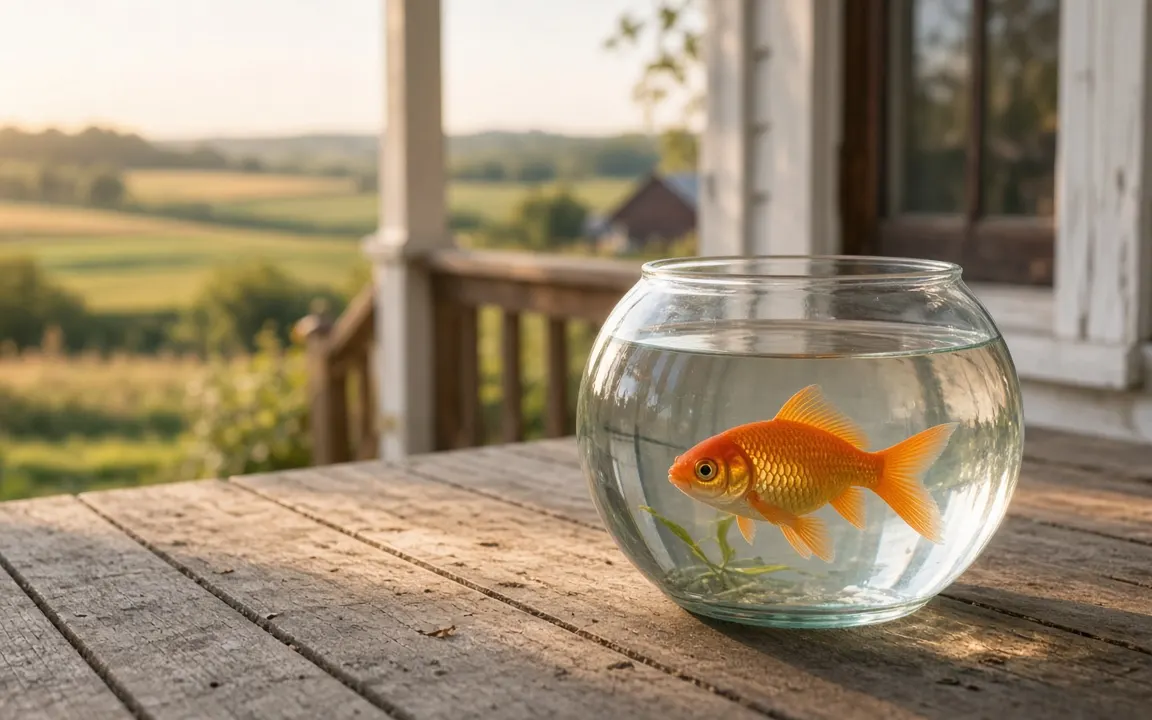
Santa Fe, New Mexico
What happens when a pet fish dies in Santa Fe
Santa Fe sits at about 7,000 feet at the foot of the Sangre de Cristo Mountains, some 56 miles northeast of Albuquerque. Homes range from old adobes on narrow lanes near the Plaza to houses on acreage out in the county, reached by winding dirt roads. When asking for a home collection, give clear directions and mention whether a vehicle can reach your door in snow or mud.
Trails in the foothills, the Santa Fe River's shaded path and the piñon-and-juniper country around town are where many residents head with their animals. National forest and other public land may require permission for scattering, so check before you go. Roughly 70.5% of New Mexicans are cremated, well above the national figure, so cremating a pet here raises few eyebrows among family or neighbors.
Families near Santa Fe sometimes lose several pond fish at once after a storm, a power cut to the pump or a hot, still night. It's upsetting to find, and the first job is the survivors: remove the dead fish, get air moving in the water and test it. Once that's done, you can freeze the fish you lost and decide calmly whether they'll be buried together, cremated communally or cremated individually.
About 89,837 people live in Santa Fe, which makes it the 4th-largest of the 11 New Mexico communities we cover. The nearest larger centre is Albuquerque, about 56 miles (90 km) away, which is where some providers serving Santa Fe are based.
For a second opinion on price, Rio Rancho (51 miles), Taos (54 miles) and Albuquerque (56 miles, a larger centre) are close enough that their providers cover Santa Fe routinely. Two written quotes tell you more than any price list.
70.5%[1]
The NFDA projected New Mexico's cremation rate at 70.5% for 2024.
10 million[2]
About 10 million US households keep freshwater fish.
13%[3]
13% of UK households keep an indoor fish tank.
3-5% of body weight[4]
Embrace notes cremated remains typically weigh about 3-5% of the pet's original body weight.
Sources for the statistics above: UK Pet Food (formerly PFMA) Pet Population 2026 and Embrace Pet Insurance.
Local attitudes to cremation
Cremation is the everyday choice in New Mexico: about 70.5%[1] of people who die there are cremated. That familiarity tends to carry over to pets, and it helps fish owners too. Crematories here are used to small animals, so asking about a koi or a goldfish rarely raises an eyebrow. Where it can get awkward is the tiniest fish, and a provider that's honest about how little ash a betta leaves is worth choosing over one that simply takes your money.
The New Mexico figure comes from NFDA 2024 Cremation & Burial Report state projections (via Occasional Sage) (2024). It describes people, not pets, so read it as a sign of local attitudes rather than a pet statistic.
Santa Fe weather, ponds and timing
Santa Fe winters are cold, with average lows at or below freezing in January, February, March, November and December. Pond fish slow right down in winter and live under the ice, but they still need a small opening for gases to escape. Many keepers use a floating de-icer or keep an air pump running near the surface. Losses under the ice, sometimes called winterkill, are usually only discovered when the pond thaws.
Cold water hides problems in Santa Fe. Fish in an iced-over pond barely eat and their immune systems slow right down, so an infection picked up in autumn may only show itself in spring. If fish die as the water warms after January, February, March, November and December, a vet who treats fish can learn far more from a fresh, chilled body than a frozen one. Decide before you bag the fish: fridge if you want answers, freezer if you just need time.
Paying for a fish's goodbye in Santa Fe
Cost is a fair worry, even for a small pet. In one US survey of pet owners, 61%[5] said the cost of aftercare was a concern. The good news for fish keepers in Santa Fe is that there are low-cost options: communal cremation through a vet, a garden or planter burial that costs next to nothing, or a private cremation only for the larger fish where ash is worth keeping.
Rather than repeat the price table on every city page, we keep one for New Mexico: New Mexico costs. What each service includes is on the services page.

Free tool
Cremation cost calculator
Estimate a realistic price range for your pet's size, location and the type of cremation.
The legal side of losing a fish in New Mexico
You don't need a permit to have a fish cremated, but what you do with the body or the ashes can be governed by local rules. The most important one for fish keepers applies to living fish: never release a fish, or empty a pond or tank, into a creek, lake or drain. Many places restrict releasing non-native fish because they can spread disease and crowd out wildlife.
Home burial and scattering are governed at the New Mexico level first; our New Mexico rules summary has the detail. Then check whether Santa Fe or your HOA adds anything.
The first day after a fish dies
- If a sitter finds your fish dead while you're away, ask them to lift it out gently, wrap it in kitchen paper and freeze it in a labeled bag.
- Ask for a quick photo of the tank or pond plus a mention of anything odd, like a pump that's gone quiet or water turning cloudy.
- Have them check the others and, if the water doesn't look right, turn any automatic feeder off.
- Make no aftercare decisions from a distance. Once frozen, your fish can wait for your return.
- When you're back, test the water yourself, then choose between burial and cremation calmly.
- Thank your sitter. Discovering a dead pet is hard on the person who finds it, whoever the fish belonged to.
Keeping your fish part of the family story
Santa Fe's altitude brings warm summer days in the mid-80s and properly cold winters, with December lows near 18F and freezing nights from November into March. Snow is common. A pet's body keeps longer in a cold room during winter, though icy roads can slow a collection; in summer, arrange one within the day and keep the body out of the strong high-altitude sun.
or see how other readers answered in our polls, there are guides for the big decisions and articles for the details, Our services overview lays out every option side by side, try the free planning tools. If you live between Santa Fe and Rio Rancho, Albuquerque, Roswell and Las Cruces, either page applies. Every other community in New Mexico, and all of the United States, is listed too.

Reader polls
What would you choose?
Vote anonymously and see how other readers answered. The results are live counts from people who visit this site, so they show real opinions, not a scientific sample.
What would you choose for a fish you loved?
Tap an answer to vote and see how others answered. Anonymous.
Was a fish your child's first pet?
Tap an answer to vote and see how others answered. Anonymous.
If you had to decide today, which aftercare would you choose for your pet?
Tap an answer to vote and see how others answered. Anonymous.

Free tools to help you plan
Cremation cost calculator
Estimate a realistic price range for your pet's size, location and the type of cremation.
Ashes weight estimator
See roughly how much ash to expect back, by species and body weight.

Aftercare options compared
Compare private, communal and water cremation with burial on cost, timing and what comes home.
Questions people ask
How do New Mexico attitudes to cremation compare?
NFDA 2024 Cremation & Burial Report state projections (via Occasional Sage) (2024) puts the New Mexico human cremation rate at about 70.5%[1]. We show it on the Santa Fe page because pet aftercare choices tend to track it: where cremation is normal for people, communal and private pet cremation are both easy to find.
Does the Santa Fe climate change what I should do first?
Only the timing. In July, with highs near 86°F, cool the body and book collection the same day. In January, February, March, November and December, when lows sit below freezing, a home burial may have to wait for a thaw, so cremation with ashes returned keeps your options open.
Can a provider from a neighbouring town collect from Santa Fe?
Usually yes. Rio Rancho is about 51 miles away, Taos is about 54 miles away and Albuquerque is about 56 miles away, all inside a normal collection radius. Get the mileage written into the quote so there is no surprise on the day.
Will I have to travel to Albuquerque to arrange things?
Not usually. Providers based in Albuquerque (roughly 56 miles from Santa Fe) collect from here as a matter of routine, and the paperwork is done by email or phone. If you want to be present for a witnessed cremation, that is when the drive matters.
Is it illegal to release a pet fish in New Mexico?
Releasing non-native fish into lakes, rivers and ponds is restricted in many US states, and some make it illegal to release goldfish at all. Rules vary by state, so check with your state wildlife agency. Whatever the law, releasing a fish you can't keep harms native wildlife. Pet stores, fish clubs and rehoming groups can often take unwanted fish.
Does New Mexico regulate pet crematories?
Only nine US states have laws written specifically for pet crematories, and only two require written documentation for consumers. Elsewhere, it's up to you to ask. For a fish, ask in writing whether the cremation is private, communal or partitioned, how your fish is identified and what will be returned for its size.


Sources and our estimates
- [1] The NFDA projected New Mexico's cremation rate at 70.5% for 2024. NFDA 2024 Cremation & Burial Report state projections (via Occasional Sage), 2024.
- [2] About 10 million US households keep freshwater fish. American Pet Products Association (APPA) 2025 National Pet Owners Survey release, 2025.
- [3] 13% of UK households keep an indoor fish tank. UK Pet Food (formerly PFMA) Pet Population 2026, 2026.
- [4] Embrace notes cremated remains typically weigh about 3-5% of the pet's original body weight. Embrace Pet Insurance - Bury or Cremate Your Dog? Costs, Pros & Cons, 2025.
- [5] 61% of US owners in the Cooney survey rated the cost of after-death body care as a concern (27.9% concerned, 33.1% very concerned). Cooney, Kogan, Brooks, Ellis - Pet Owners' Expectations for Pet End-of-Life Support and After-Death Body Care, Topics in Companion Animal Medicine (2020), 2020.
- [6] The median price multiple of private (ashes returned) over communal cremation across 8 markets is about 2.0x, ranging from 1.25x (Tokyo) to 5.2x (Auckland). Our estimate: median(private_price / communal_price) same weight band: US CareCredit 51-70 lb midpoints (250/75) = 3.33x; Auckland 15-25 kg (445/85) = 5.24x; Norway 1-20 kg (3790/1190) = 3.18x; Singapore 10-20 kg (480/260) = 1.85x; Ontario 25-250 lb (549/279) = 1.97x; Tokyo 20-30 kg (38500/30800) = 1.25x; France 20 kg midpoints (200/95) = 2.11x; Germany range midpoints (270/145) = 1.86x. How we calculate.
Find a Santa Fe provider that accepts fish
Tell us what you need and where you are. We'll reply by email with clear options and prices so you can decide in your own time.