Saying goodbye to a pet fish in Saint Paul
Fish are real pets, and some live for decades. We explain fish cremation in Saint Paul in plain words, including when a small fish is better honored another way.
- Providers that actually accept fish
- Honest ash estimates before you pay
- Gentle options for tiny tank fish
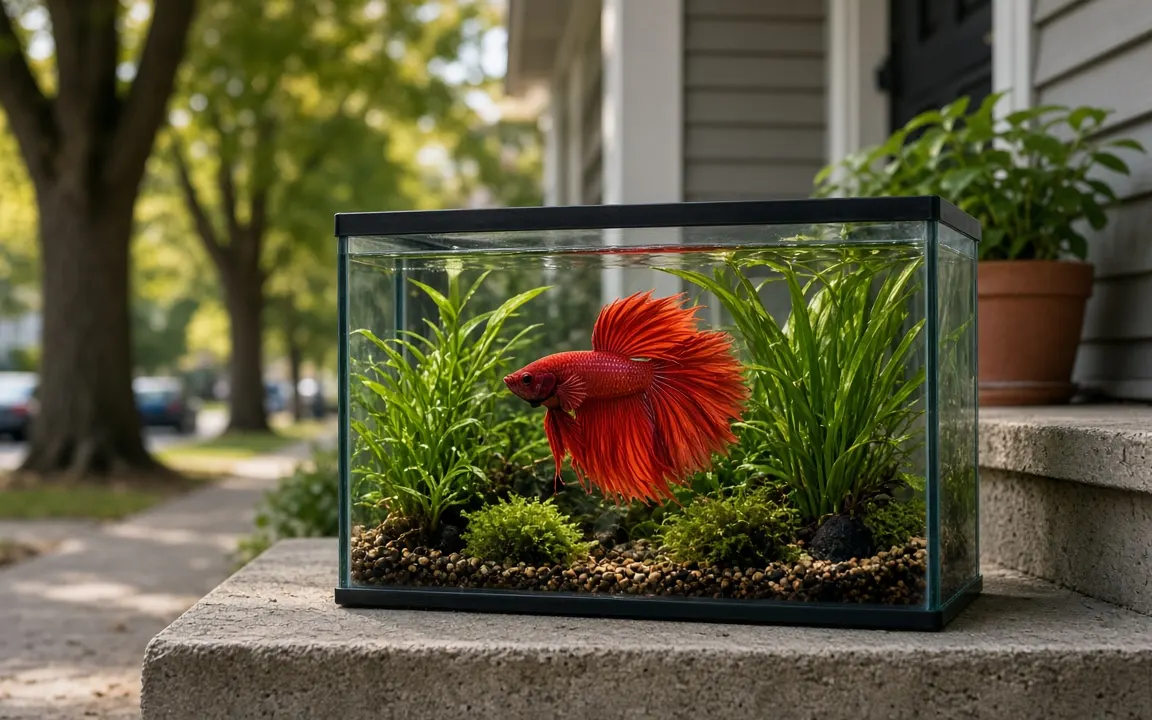
Saint Paul, Minnesota
Getting help with a fish loss around Saint Paul
People in Saint Paul tend to remember pets close to home and close to the river. The Mississippi bluffs, Crosby Farm Regional Park and the paths around Como Lake are the kind of places families picture when they think about a pet's favorite outings. If you're thinking of scattering ashes somewhere public, choose a quiet spot and ask the park authority first. Many families simply keep the ashes at home and plant something in the garden when the ground thaws.
Saint Paul mixes older neighborhoods of wood-frame houses and duplexes, like the streets around Summit Avenue and Highland Park, with apartments downtown and along University Avenue. Many homes have steep front steps and narrow side yards, so if you'd like your pet collected from home, mention stairs, alley access and where a vehicle can park. Minneapolis is next door, which widens the choice of providers, but it also means asking where the cremation actually takes place.
Some providers that serve Saint Paul are based out of town or near a larger city such as Minneapolis, because crematories need space and permits. That's normal and doesn't mean a worse service. What matters for a fish is whether they accept it, whether they'll tell you honestly what will be returned and how long it takes. Freezing your fish first means distance and scheduling don't have to be rushed.
Saint Paul is home to about 311,000 people, the 2nd-largest of the 67 Minnesota communities we cover. Some of the providers who serve Saint Paul are based about 9 miles away in Minneapolis, the nearest larger centre, so collection times reflect that drive.
The closest communities we cover are West St. Paul (4 miles), South St. Paul (5 miles) and Roseville (5 miles). Providers serving those towns often travel to Saint Paul too, so it can be worth asking them for a quote.
68.5%[1]
The NFDA projected Minnesota's cremation rate at 68.5% for 2024.
10 million[2]
About 10 million US households keep freshwater fish.
13%[3]
13% of UK households keep an indoor fish tank.
3-5% of body weight[4]
Embrace notes cremated remains typically weigh about 3-5% of the pet's original body weight.
The numbers above come from American Pet Products Association (APPA) 2025 National Pet Owners Survey release and Embrace Pet Insurance, if you'd like to read the original sources.
What local funeral customs suggest for a pet fish
Roughly 68.5%[1] of funerals in Minnesota end in cremation, so plenty of families mix both traditions, and couples sometimes disagree over a fish. One wants a grave by the pond; the other wants something to keep. A compromise works well: cremate the fish, keep a little of the ashes indoors and bury the rest beside a marginal plant near the water. Ashes carry no disease, so the pond stays safe, and you get both a keepsake and a place to visit.
NFDA 2024 Cremation & Burial Report state projections (via Occasional Sage) (2024) is where the Minnesota figure comes from. It counts people; we use it because attitudes to cremating a pet in Saint Paul tend to follow attitudes to cremation generally.
Season by season: fish losses in Saint Paul
Some Saint Paul families choose cremation in winter precisely because the ground is frozen, then scatter or bury the ashes in spring. For a larger koi, that gives you a small urn to keep through the cold months and a chance to plan something by the pond once the ice has gone. For a small fish, the freezer and a spring burial usually make more sense.
In January, when lows in Saint Paul average around 6°F, a fish that dies can wait in an unheated garage or shed inside a lidded tub, as long as it stays frozen solid. That helps if your kitchen freezer is small. Watch for mild spells, and for animals: a tub with clip-on catches keeps raccoons, foxes and the family cat out. Move it to a freezer indoors if a thaw is forecast.
Paying for a fish's goodbye in Saint Paul
Most families receive private cremation ashes back in about 5-10 days[5], and small pets are often among the quicker ones. For a fish in Saint Paul, the price usually follows the provider's minimum for the smallest pets, as in the table below. Water cremation, where it's offered, falls in similar bands. If your fish is very small, ask whether a symbolic return costs the same as a private cremation.
Prices for Saint Paul track the wider Minnesota market, so use the Minnesota price table as your baseline and the services page to see what is included.

Free tool
Cremation cost calculator
Estimate a realistic price range for your pet's size, location and the type of cremation.
The legal side of losing a fish in Minnesota
You don't need a permit to have a fish cremated, but what you do with the body or the ashes can be governed by local rules. The most important one for fish keepers applies to living fish: never release a fish, or empty a pond or tank, into a creek, lake or drain. Many places restrict releasing non-native fish because they can spread disease and crowd out wildlife.
The official Minnesota local government directory lists every county and city office, which is the quickest way to find who to ask in Saint Paul.
The rules that apply across Minnesota (home burial, scattering and who oversees pet cremation) are summarized on our Minnesota page. Saint Paul may add its own conditions, so check with the city or county before digging.
A checklist for Saint Paul fish keepers
- If your child's fish dies while they're at school, either leave the fish in place or put it somewhere cold, then be honest with them once they're home.
- Skip the secret replacement. Children usually notice, and the truth is easier to handle than a discovery later.
- Let them see the fish if they want to, resting in a soft cloth, and give plain, simple answers to whatever they ask.
- Offer two or three choices for how to say goodbye: a windowsill flowerpot, a place in the garden or a little box they can hold on to.
- Set a time for the goodbye, giving them a chance to write a card, find a stone or think of words.
- Leave the tank empty for a while before talking about a new fish, unless your child asks sooner.
Keeping a fish's memory close
Winter shapes aftercare in Saint Paul more than almost anywhere. From November through March the ground is usually frozen hard, so a backyard burial may have to wait until spring, and many families choose cremation for that reason alone. The upside of the cold is time: a pet wrapped and kept in an unheated garage or porch stays cool. In a humid July heat wave it's the opposite, and a cool room and ice packs matter within hours.
the planning tools turn your pet's details into figures, the guides answer the longer questions and the blog the newer ones, See what each option includes on our services page, or look at how readers voted in our polls. You can also browse every city in the United States. Nearby, we also cover Minneapolis, Duluth, Brooklyn Park and Rochester, and every city in Minnesota.

Reader polls
What would you choose?
Vote anonymously and see how other readers answered. The results are live counts from people who visit this site, so they show real opinions, not a scientific sample.
Was a fish your child's first pet?
Tap an answer to vote and see how others answered. Anonymous.
Would you keep your fish in the freezer while you decide what to do?
Tap an answer to vote and see how others answered. Anonymous.
If you had to decide today, which aftercare would you choose for your pet?
Tap an answer to vote and see how others answered. Anonymous.

Free tools to help you plan
Cremation cost calculator
Estimate a realistic price range for your pet's size, location and the type of cremation.

Ashes weight estimator
See roughly how much ash to expect back, by species and body weight.

Aftercare options compared
Compare private, communal and water cremation with burial on cost, timing and what comes home.
Questions people ask
Is cremation common in Minnesota?
For people, yes: about 68.5%[1] of Minnesota deaths end in cremation, according to NFDA 2024 Cremation & Burial Report state projections (via Occasional Sage) (2024). Nobody publishes the same figure for pets, but in our experience pet choices in Saint Paul follow the human pattern closely, so cremation is the default most families here start from.
Which nearby towns can I compare with Saint Paul?
The closest communities we cover are West St. Paul (about 4 miles), South St. Paul (about 5 miles) and Roseville (about 5 miles). Providers based in those places often serve Saint Paul too. Ask each one for a written total that includes collection, so the distance is priced in.
When is the hardest time of year to arrange a burial in Saint Paul?
January, February, March, November and December: average lows are below freezing then, and frozen ground makes a home grave slow or impossible until it thaws. The other pressure point is July, when highs around 81°F mean a body needs cooling and collecting quickly.
Will I have to travel to Minneapolis to arrange things?
Not usually. Providers based in Minneapolis (roughly 9 miles from Saint Paul) collect from here as a matter of routine, and the paperwork is done by email or phone. If you want to be present for a witnessed cremation, that is when the drive matters.
What can I keep if my fish was too small to leave ashes?
Plenty. A framed photo, a painting or print of the fish, its favorite tank ornament, a plant grown over a garden burial or a painted stone all work. Some crematories offer a token vial with a certificate, though the contents may be mostly from the chamber. Ask what's inside before you pay, and choose whatever feels like your fish.
Where can I bury a fish if I live in an apartment in Saint Paul?
A large planter on a balcony or windowsill works well for a small fish. Wrap it in paper, bury it in fresh compost and plant something on top. Don't bury pets in public parks or communal gardens without permission. If you'd rather not bury at all, communal cremation through a vet is a simple option.


Sources and our estimates
- [1] The NFDA projected Minnesota's cremation rate at 68.5% for 2024. NFDA 2024 Cremation & Burial Report state projections (via Occasional Sage), 2024.
- [2] About 10 million US households keep freshwater fish. American Pet Products Association (APPA) 2025 National Pet Owners Survey release, 2025.
- [3] 13% of UK households keep an indoor fish tank. UK Pet Food (formerly PFMA) Pet Population 2026, 2026.
- [4] Embrace notes cremated remains typically weigh about 3-5% of the pet's original body weight. Embrace Pet Insurance - Bury or Cremate Your Dog? Costs, Pros & Cons, 2025.
- [5] A US aftercare guide says many families receive private cremation ashes within about one to two weeks, with 5-10 days commonly quoted. Funeral.com - Pet Cremation Timelines: How Long Until Ashes Are Returned, 2026.
- [6] Private cremation cost per pound falls with size in the US: roughly $9.2/lb for a 15 lb pet, $4.2/lb at 60 lb and about $4.0/lb at 100 lb. Our estimate: band midpoint price / representative weight: 0-30 lb (midpoint $137.50 / 15 lb) = $9.17/lb; 51-70 lb ($250 / 60 lb) = $4.17/lb; over 90 lb ($400 / ~100 lb) = $4.00/lb. How we calculate.
Get fish cremation options in Saint Paul
Tell us what you need and where you are. We'll reply by email with clear options and prices so you can decide in your own time.