Eco-friendly aftercare for fish: which green claims hold up?
For a single small fish, every aftercare choice has a tiny footprint, so the greenest decision is usually about water, not carbon: never release live fish and keep disease out of streams and ponds. For a large koi, water cremation does use far less energy than flame.
By the Fish Cremation & Memorial Services editorial team · Updated September 24, 2026 · 6 min read · Sources
- What the research says about aquamation vs flame
- How to test a "biodegradable" or "green" label
- The real eco risks for fish keepers
The short answer
What is the most eco-friendly aftercare for a fish?
For most fish, the environmental difference between aftercare options is small because the animal is small. What really matters is keeping disease and unwanted fish out of local waters. For a heavier koi, water cremation (aquamation) uses much less energy than flame, and a carefully sited burial is a low-impact choice too.
Interest in greener goodbyes is real. In one market report, 40%[1] of consumers said they had environmental concerns about pet aftercare, and the National Funeral Directors Association's 2024 consumer survey found 68%[2] of people interested in green funeral or natural burial options. That demand is also why "eco" labels appear on things that don't always deserve them.
Had you heard of water cremation (aquamation) before today?
Tap an answer to vote and see how others answered. Anonymous.
The main comparison
Is water cremation really greener than flame cremation?
On energy and carbon, the evidence points clearly toward water cremation. Aquamation, also called alkaline hydrolysis, breaks down the body in warm water and alkali instead of burning it. The Veterinary Sustainability Alliance says pet systems run for about 12–20 hours at 200°F[3], far cooler than a flame chamber.
about 1/10[4]
Alkaline hydrolysis has about a tenth of the carbon footprint of conventional cremation, according to People's Memorial Association's Nora Menkin.
7x less[5]
Alkaline hydrolysis produces about seven times less CO2 than cremation (Keijzer study, via BBC).
90%+[6]
Alkaline hydrolysis offers over 90% energy savings compared with flame-based cremation, according to industry research cited by Connecting Directors.
Those figures come from human-scale studies. The most detailed, a Dutch life-cycle assessment by TNO, put an average flame cremation at 79.9 kg CO2e[7] per body, and alkaline hydrolysis at -31.8 kg CO2e[8], a net negative figure because it credited recycled metals and avoided products. Industry sources suggest aquamation has about a tenth of the carbon footprint, and a separate Dutch study estimated around seven times less CO2.
Water use is the usual objection. For pets it's modest: roughly the water of 1–3 pet baths[9] per animal, and a fish is at the very small end of that. The treated liquid goes to the sewer, where it is handled like other wastewater, subject to local permits.
Reading labels
Are "biodegradable" urns and memorials what they claim?
Often, but the word alone doesn't tell you much. Almost anything is biodegradable given enough time. What you want to know is what it's made of, how long it takes to break down, and in what conditions. A recycled-paper urn in moist garden soil behaves very differently from a "plant-based plastic" urn that only breaks down in an industrial composter.
- Material: paper, cardboard, untreated wood, salt, sand or plant fiber are straightforward. "Bioplastic" needs a closer look.
- Timeline: a maker should be able to say roughly how long in soil or water.
- Conditions: does it need industrial composting, or will it break down in your yard?
- Additives: dyes, glues and glossy coatings can be the least green part.
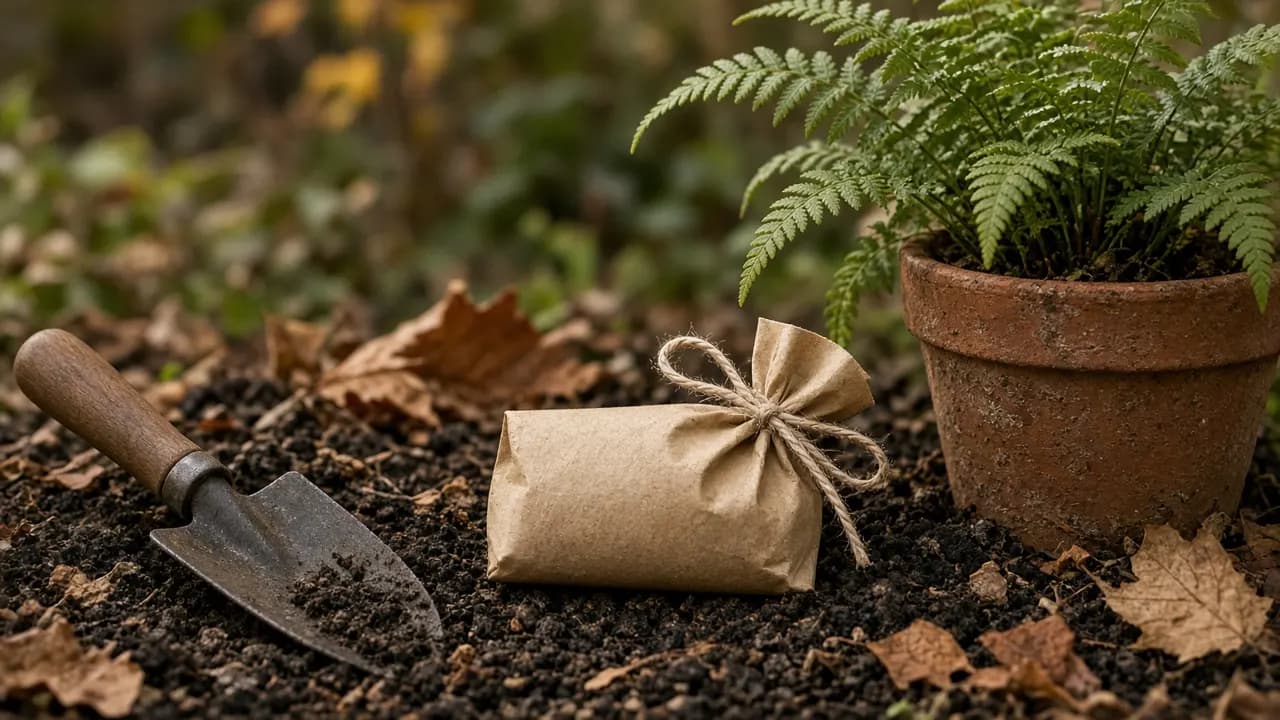
For a small amount of fish ash, the simplest option is often a plain paper envelope or cotton pouch buried in a planter. Our guide to bio memorials after fish loss covers plantable urns and water-soluble options in more depth.
The biggest impact
What's the real environmental risk for fish keepers?
It isn't carbon. The genuine environmental harm in the fish hobby comes from releasing live fish and spreading disease into wild water. A released goldfish can grow to nearly two feet and six pounds in a lake, where it can crowd out native species [11]. Minnesota has made that illegal, and its natural resources agency tells owners to never release[12] unwanted goldfish, and instead to return them to a retailer, rehome them or ask a vet about humane options.
- Never release a live fish into a pond, stream, lake or storm drain, even a sick one you can't bear to euthanize.
- Don't dump tank water outdoors near waterways if your fish had disease; pour it down a sink or toilet connected to treatment, or onto dry ground well away from water.
- Don't compost a fish that died of disease in an open heap near a pond or stream, where birds and raccoons can move it.
- Talk to an aquatic vet or fish store about humane euthanasia for a suffering fish rather than letting it go.
These steps do more for the environment than the choice between flame and water cremation ever will. In the US, the Habitattitude campaign, run with the US Fish and Wildlife Service and NOAA, lists alternatives to releasing aquarium pets.
If you're burying
Is burying a fish near a pond or stream a good idea?
Keep burial well away from water. A grave on the pond bank may feel poetic, but runoff can carry decomposition and any pathogens back into the pond, and high water tables make shallow graves unreliable. Choose a spot uphill and at a distance from ponds, wells, streams and ditches, and bury deep enough that herons, raccoons and foxes can't get to it.
Burial is still a very low-impact goodbye, especially for small fish. A marker or planting nearby, rather than at the water's edge, gives you a place to visit. Our guide to pond-side markers after koi loss has ideas for marking a spot within sight of the pond without disturbing the bank.
Scattering and planting
Can fish ashes harm plants or pond water?
In quantity, yes. Cremated remains are strongly alkaline, at a pH of ~11.7[13], which can damage roots and shift pond chemistry. The small amount from a single fish is rarely a problem when it's spread thinly over a garden bed, but pouring ashes into a small pond or straight around one plant isn't ideal.
If you want to plant with ashes, mix them well into compost or soil and let the mixture rest. Gardening advice suggests waiting 90–120 days[14] before planting into it. Water-dissolving urns designed for lakes belong on large public waters where scattering is allowed, never in a fish pond.
Checking the claims
What questions test a provider's green claims?
A good provider will answer these without hesitation. If they get vague or defensive, treat the "eco" label with caution.
- Is this water cremation or flame? If flame, what fuel does the chamber use?
- For aquamation, how is the effluent handled, and is it permitted by the local water authority?
- Is the cremation private or communal? Communal spreads energy across several animals.
- What exactly is the urn or container made of, and how long does it take to break down?
- Is there a certification or third-party standard behind the green claim, and can I see it?
- For a small fish, will anything be returned at all?
Our full list of questions to ask a fish cremation provider covers pricing, labeling and returns, and private vs communal cremation for fish weighs the two main types.
Putting it together
How do you choose once the green claims are sorted?
Once you've set aside the marketing, the decision usually comes down to the fish's size, what you'd like to keep and what's available near you. Aquamation isn't offered everywhere, and where it is, prices tend to be in the same broad range as flame cremation. The services page explains each option for fish of different sizes.
The aftercare options comparison weighs burial, flame cremation and water cremation against what matters most to you, including environmental impact. If you'd like to know what's offered near you, send us your details and we'll reply by email. You can also read how we check environmental figures on our research page.

Free tool
Aftercare options compared
Compare private, communal and water cremation with burial on cost, timing and what comes home.

Reader polls
What would you choose?
Vote anonymously and see how other readers answered. The results are live counts from people who visit this site, so they show real opinions, not a scientific sample.
What would you choose for a fish you loved?
Tap an answer to vote and see how others answered. Anonymous.
Had you heard of water cremation (aquamation) before today?
Tap an answer to vote and see how others answered. Anonymous.
If you had to decide today, which aftercare would you choose for your pet?
Tap an answer to vote and see how others answered. Anonymous.

Questions people ask
Is aquamation available for fish?
Many pet aquamation providers accept fish, including koi and large goldfish, though availability varies by region and it's less common than flame cremation. Ask whether the fish will be processed individually, how much bone mineral they expect to return for its size, and whether the price differs from their flame service.
Is burying a fish better for the environment than cremating it?
For a small fish, burial has a very low footprint: no fuel, no transport and no packaging. The key is placement, away from water and deep enough to deter scavengers. If the fish died of an unknown illness, cremation removes any disease risk, which can be the more responsible choice near a pond.
Can I compost a dead fish?
A small fish can be composted in a hot, well-managed pile, but open heaps attract raccoons, cats and birds, and a diseased fish shouldn't be composted near ponds or streams. Many keepers find burial in a large planter or garden bed simpler and just as natural for a tiny fish.
Are water-soluble urns safe to use in my koi pond?
No. They're designed for large lakes or the sea, where the ash disperses widely. In a garden pond, the alkaline ash and dissolving urn material can change water chemistry and stress living fish. Scatter or bury ashes in soil nearby instead, mixed well with compost.
Is releasing a fish into a lake a kind alternative to euthanasia?
No. Released aquarium and pond fish can spread disease, compete with native species and in many places it's illegal. Goldfish in particular can grow very large in the wild. If you can't keep a fish, return it to a store, rehome it with a hobbyist, or ask an aquatic vet about humane euthanasia.


Sources and our estimates
- [1] Astute Analytica reports that 40% of consumers raise environmental concerns about pet aftercare choices. Astute Analytica via GlobeNewswire — Global Pet Preservation Services Market to Hit USD 112.7 Million by 2032 (Apr 2, 2024), 2024.
- [2] 68% of respondents to NFDA's 2024 Consumer Awareness and Preferences Survey expressed interest in green funeral or natural burial options. NFDA — Green Burial Resources for Funeral Professionals, 2024.
- [3] Pet alkaline hydrolysis systems run at about 200°F at atmospheric pressure with a 5% alkaline solution for 12–20 hours. Veterinary Sustainability Alliance — Aquamation, 2024.
- [4] Alkaline hydrolysis has about a tenth of the carbon footprint of conventional cremation, according to People's Memorial Association's Nora Menkin. National Geographic — The environmental toll of cremating the dead (2019), 2019.
- [5] Alkaline hydrolysis produces about seven times less CO2 than cremation (Keijzer study, via BBC). Connecting Directors — The Real Impact of Alkaline Hydrolysis (Disposition Eco-Impact, Part 3 of 5), 2014.
- [6] Alkaline hydrolysis offers over 90% energy savings compared with flame-based cremation, according to industry research cited by Connecting Directors. Connecting Directors — The Real Impact of Alkaline Hydrolysis (Disposition Eco-Impact, Part 3 of 5), 2023.
- [7] A TNO life-cycle assessment estimated the global-warming impact of an average cremation at 79.9 kg CO2-equivalent per body. TNO report TNO-060-UT-2011-01432, 'Environmental impact of different funeral technologies' (Keijzer & Kok, 2011), 2011.
- [8] The same TNO assessment put resomation (alkaline hydrolysis) at -31.8 kg CO2e per body, a net negative figure driven by credits for recycled metals and avoided products. TNO report TNO-060-UT-2011-01432, 'Environmental impact of different funeral technologies' (Keijzer & Kok, 2011), 2011.
- [9] Aquamation uses about the same water per pet as 1–3 pet baths. Veterinary Sustainability Alliance — Aquamation, 2024.
- [10] Each shelter-animal flame cremation emits about 31 kg CO2e on average. Our estimate: 19,000 t CO2e / 607,000 animals. How we calculate.
- [11] Goldfish typically live 6-7 years, usually grow 5-8 inches but can approach 2 feet and 6 pounds; releasing them into Minnesota waters is illegal. Minnesota DNR - Goldfish (Carassius auratus) invasive species page.
- [12] Minnesota DNR advises owners of unwanted goldfish to return them to a retailer, use a surrender event, rehome with hobbyists, or ask a veterinarian or pet retailer about humane disposal, never releasing them. Minnesota DNR - Goldfish (Carassius auratus) invasive species page.
- [13] Cremated remains have a very high pH of approximately 11.7, which is toxic to plants without amendment. Larkspur Conservation — Giving Cremated Remains a New Life Through Science, 2024.
- [14] Gardening Know How advises letting an ash/soil-amendment mixture sit for at least 90 to 120 days before planting. Gardening Know How — Planting With Cremains: Is There a Safe Way to Bury Ashes, 2024.
Ask about water cremation and green options near you
Tell us what you need and where you are. We'll reply by email with clear options and prices so you can decide in your own time.